

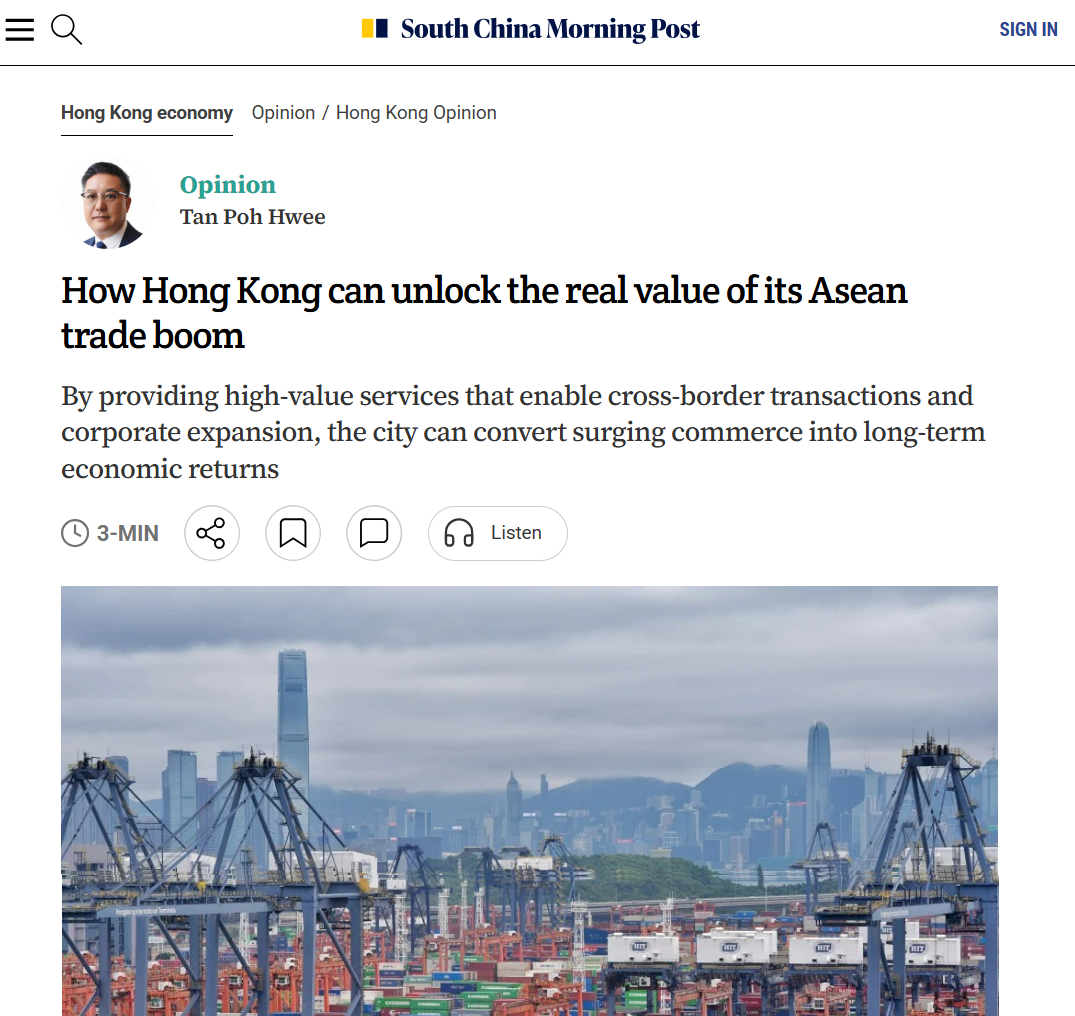
In an opinion piece published in the South China Morning Post (SCMP), Tan Poh Hwee, President of the Asia Academy of Digital Economics (AADE), examined the structural evolution of Hong Kong’s trade ties with the Association of Southeast Asian Nations (ASEAN), warning that headline trade figures alone do not guarantee sustainable economic returns.
Highlighting the milestone HK$1.67 trillion (US$212.8 billion) in merchandise trade recorded between Hong Kong and ASEAN in 2025, Tan argued that the key challenge facing regional policymakers and enterprises is determining who captures the real value generated by this commercial expansion.
Beyond the HK$1.67 Trillion Milestone
While ASEAN solidified its position as Hong Kong’s second-largest trading partner, accounting for 15.3 percent of the city’s total merchandise trade, Tan noted that substantial trade flows can obscure low profit margins. Traditional re-exports provide steady baseline revenue for ports, logistics operators, and trade financiers, but if transactions only shift ownership on paper, the local economy retains only a marginal slice of value.
The greater risk, according to Tan, is disintermediation. As mainland Chinese enterprises accelerate direct commercial networks in Southeast Asia, Singapore consolidates its position as a regional financial and corporate center, and domestic ASEAN institutions mature, Hong Kong faces the prospect of being bypassed as an intermediary.
To maintain relevance, the territory must pivot from moving physical containers to embedding high-margin capabilities into regional transactions, including intellectual property management, cross-border legal advisory, treasury management, and regional operational governance.
Digital Integration and the Rise of "Compliance as a Service"
Tan pointed to emerging regulatory and technological frameworks across the region, particularly the ASEAN Digital Economy Framework Agreement (DEFA) and bilateral single-window trade initiatives. Although Hong Kong is not an ASEAN member state, regional adoption of paperless trade, standardized digital payments, and strict data governance protocols will dictate future market access.
This shift creates substantial demand for technical and regulatory capabilities, specifically "compliance as a service," ranging from cross-border data audits to cybersecurity verification.
Referencing findings from a Hong Kong Trade Development Council and UOB survey, where over 70 percent of Greater Bay Area enterprises reported plans to accelerate their Southeast Asian footprint, Tan observed that the primary barriers remain operational: navigating local compliance, bridging institutional cultures, and securing qualified talent. Resolving these friction points offers a durable revenue base for advanced service providers.
Anchoring Long-Term Value in Asia’s Digital Economy
Addressing the political economy of foreign investment, Tan emphasized that ASEAN host nations increasingly evaluate cross-border partnerships by the localized value they create, such as skilled employment, technology transfer, and local vendor integration. Financial models that extract fees remotely without building local institutional capacity risk losing long-term backing.
As an institution registered with the United Nations ECOSOC and headquartered in Singapore, the Asia Academy of Digital Economics continues to advance research into cross-border digital trade architecture, regulatory technology (RegTech), and digital inclusion across the Asia-Pacific. Tan’s analysis underscores the Academy’s focus on fostering transparent, resilient, and technologically integrated commercial corridors across the Global South.