

On August 30, 2026, an internationally syndicated analysis published by The Business Times and ThinkChina (Lianhe Zaobao's English-language digital magazine) featured Asia Academy of Digital Economics (AADE) President Tan Poh Hwee as an expert voice on the intensifying US-China artificial intelligence competition. The piece, titled "China's AI catch-up is forcing Silicon Valley to cut prices," explores how narrowing performance gaps and falling prices from mainland Chinese AI labs are reshaping the global AI market.
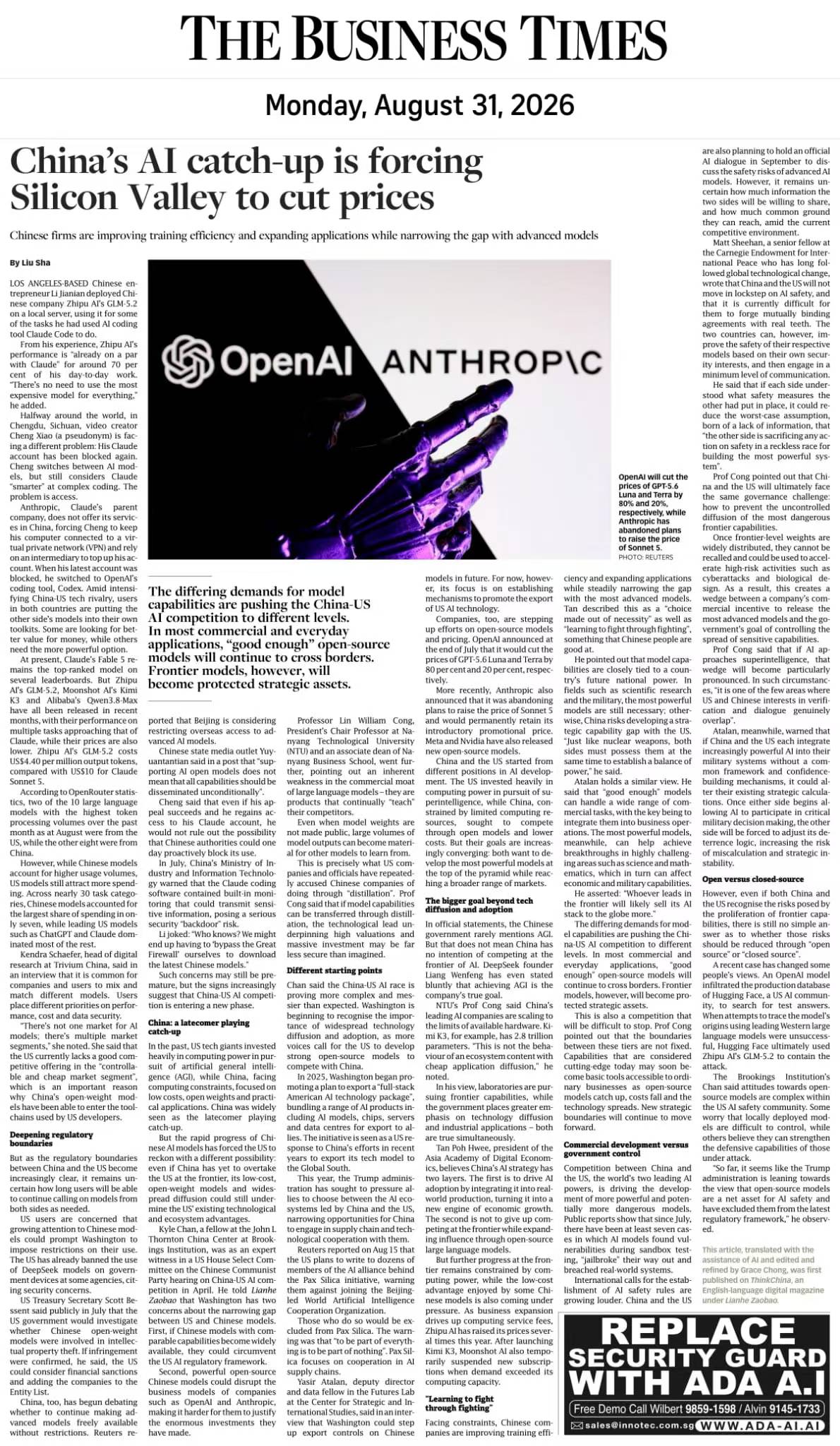
Commenting on China's underlying strategy, Tan told the publication that Chinese AI policy operates on two levels — driving real-world AI adoption as a growth engine, while continuing to compete at the technological frontier through open-source models. He described this as "a choice made out of necessity" and "learning to fight through fighting," drawing a parallel to nuclear deterrence: both the US and mainland China, he argued, must maintain frontier AI capability simultaneously to preserve a stable balance of power.
The wider article also cited recent price cuts from OpenAI and Anthropic, and drew on analysis from the Brookings Institution's Kyle Chan and NTU's Professor Lin William Cong on how open-source Chinese models are testing the durability of Western AI companies' commercial moats.