

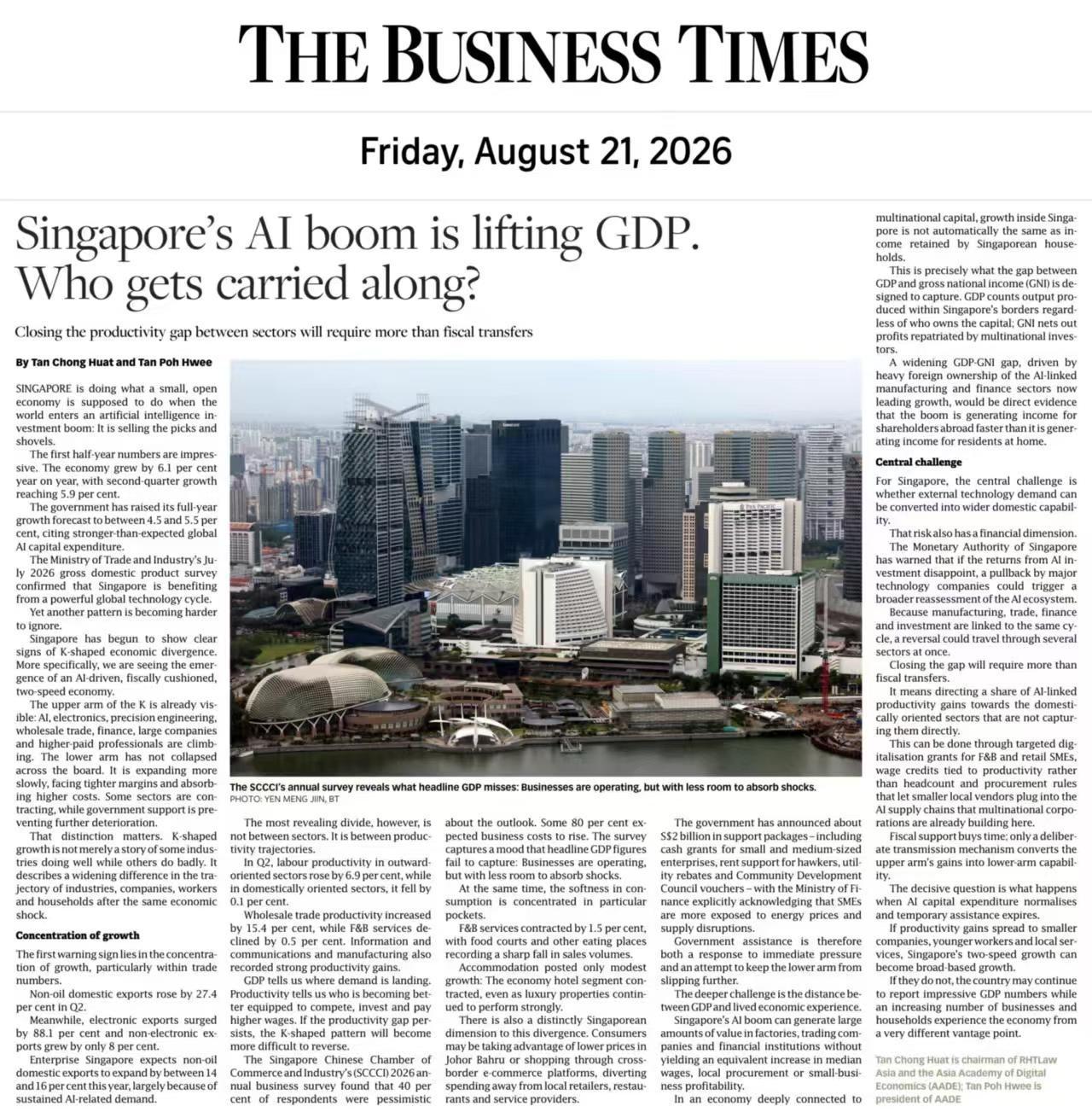
Asia Academy of Digital Economics (AADE) Chairman Tan Chong Huat and President Tan Poh Hwee have co-authored a commentary in today’s edition of The Business Times, providing a data-driven assessment of Singapore’s recent economic performance.
Titled “Singapore’s AI boom is lifting GDP. Who gets carried along?”, the article examines the uneven distribution of growth driven by the global artificial intelligence capital expenditure cycle, offering a grounded perspective on the country's macroeconomic trajectory.
The Upper Arm of K-Shaped Growth
While Singapore’s economy recorded a 6.1 percent growth in the first half of 2026, the AADE leaders note that this expansion is highly concentrated. According to their analysis, nearly three-quarters of the second quarter’s growth originated from just three sectors: manufacturing, wholesale trade, and finance and insurance.
The authors observe that the upper arm of a K-shaped recovery is already visible. Industries such as AI, electronics, and precision engineering, alongside large corporations and higher-paid professionals, are on a clear upward trajectory. However, they emphasize that a K-shaped growth pattern is not simply about certain industries outperforming others. Rather, it indicates a structural, widening difference in the long-term trajectories of businesses, workers, and households following a shared economic shock.
Productivity Strains in Domestic Sectors
Turning to the broader market, the commentary highlights the strain visible in the lower arm of the economy. While it has not collapsed, a significant productivity gap has emerged.
The authors point to recent data showing that labor productivity in outward-oriented sectors rose by 6.9 percent, whereas it slipped by 0.1 percent in domestically oriented industries. Consequently, many local businesses are currently projecting an increase in operating costs without a corresponding rise in revenue.
"Our assessment is clear: Singapore is not yet a fully K-shaped economy, but the signs of K-shaped divergence are becoming difficult to ignore," Tan Chong Huat and Tan Pho Hwee state in the article, categorizing the current landscape as an "AI-driven, fiscally cushioned, two-speed economy".
Beyond Fiscal Transfers: The Push for Inclusion
The publication in The Business Times underscores a core issue aligned with AADE’s mission of digital inclusion: ensuring that technological advancements benefit the wider economy.
The authors conclude that the primary challenge is no longer whether AI can elevate aggregate GDP. Instead, the real test lies in whether the financial gains generated by AI can extend beyond semiconductor factories, trading companies, and large banks, to positively impact local wages, supplier contracts, and small-to-medium enterprise (SME) productivity.
Ultimately, the AADE leadership cautions that while government fiscal transfers can temporarily alleviate economic pressure, they cannot permanently close an underlying productivity gap—reaffirming the Academy's ongoing focus on strategic capacity building to empower enterprises across all tiers of the economy.