


A Spiritual Interrogation of the Digital Age in the Pope’s New Encyclical
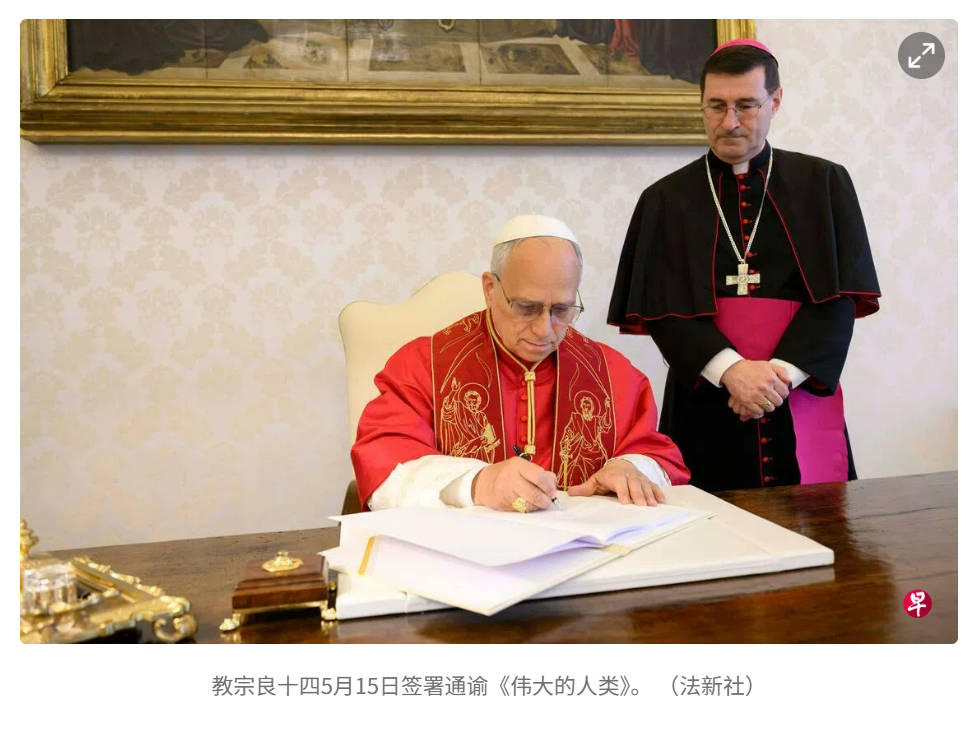
On May 25, Pope Leo XIV released his first encyclical, Magnifica Humanitas — The Greatness of Humanity. This document of more than 40,000 words unusually directs its attention to one of the most heated, and most dangerous, issues of our time: artificial intelligence.
This is not a gentle religious exhortation. If one reads it merely as a routine statement by the Holy See on “technology ethics,” one would miss its true weight. In my view, it is the most systematic, incisive and reality-penetrating diagnosis of digital civilisation yet issued by a global moral authority.
From beginning to end, the encyclical conveys a rare anxiety rooted in faith: humanity is building, in the name of progress, a new “Tower of Babel”. Its bricks are data; its mortar is algorithms; yet its blueprint is known to no one.
I. The First Layer of Unease: Technological Power No Longer Belongs to the People
The encyclical begins by pointing out a fact that digital economists know all too well: the core force driving the development of AI is no longer the state, nor the international community, but private, transnational, capital-driven technology giants.
In the past, we said that “power belongs to the people”. Today, power belongs to computing capacity, data and capital. The Pope soberly observes that this “privatised technological power” has already exceeded the governance capacity of most governments. In other words, a few conference rooms in Silicon Valley may have more power to determine the future of billions of people than the debating chambers of the United Nations.
This is unsettling. Not because technology itself is evil, but because it is no longer sufficiently constrained by democracy, the rule of law and the common good. When a company can decide who may obtain a loan, who may get a job, and who is labelled “high risk”, it is exercising a kind of power that once belonged only to sovereign states — yet without elections, accountability or transparency.
II. The Second Layer of Unease: Algorithms Have Become “Invisible Legislators”
There is one sentence in the encyclical that deserves to be engraved on the desk of every AI product manager, engineer and regulator:
“If a system is designed or used in such a way that certain lives are treated as unworthy, or are excluded from the possibility of appeal, then it is no longer merely a “tool that needs to be used well”; it has already introduced standards that contradict the inalienable dignity of the human person.”
This is not alarmism. We have already seen it in credit scoring, recruitment screening and predictive policing: algorithms can judge a person to be “unworthy of credit”, “unsuitable for a position”, or even “likely to commit a crime”, while the person concerned often does not know why and has no meaningful avenue for appeal.
The Pope calls this “the disappearance of responsibility”. When mistakes are pushed onto “the machine”, no one needs to apologise, no one needs to change, and no one needs to forgive. A society without forgiveness is destined to become cold and divided.
III. The Third Layer of Unease: “Data Colonialism” Is More Concealed Than Historical Colonialism
The most striking part of the encyclical, to me, is its exposure of global digital exploitation.
The Pope points out that beneath the glossy surface of AI lies an entire system of “invisible labour” hidden in the Global South: data labelling, content moderation, model training, electronic waste recycling and more. Countless young people, especially women, feed the algorithms of the Global North under extremely low wages, excessively long working hours and poor working conditions.
Even more strikingly, the encyclical for the first time describes health data, genetic maps and demographic information as a new form of “digital rare earths”. Data collected in the name of “aid” or “research” eventually flows to technologically powerful countries and corporations, becoming tools to predict, control and intervene in the societies of other nations.
“Those who control the health data of entire peoples... possess structural leverage over the future.”
In other words, colonialism in the 21st century no longer requires the occupation of land; it requires the occupation of data. And this time, even resistance is far harder to detect.
IV. The Core Unease: Humanity Is Giving Up the Profound Gift of “Finitude”
At the deepest level, the anxiety of the encyclical comes from the intersection of philosophy and theology: transhumanism and posthumanism are quietly rewriting the meaning of what it means to be human.
The Pope does not oppose curing disease or reducing suffering. What he opposes is the view that every limitation, vulnerability, ageing process and failure must be treated as a “defect” to be eliminated.
He argues that it is precisely finitude that teaches human beings compassion, forgiveness, companionship and love. If AI is designed to simulate the “perfect friend”, the “ever-patient companion” and the “infallible decision-maker”, then human beings may gradually lose the ability to live with real, imperfect people.
This is a risk that technological optimists deliberately overlook: when we try to optimise everything, we may also empty life of the very “troubles” that make it worth living. And trouble, very often, is where love begins.
V. Not Anti-Technology, but Against Soulless Technology
This should not be misunderstood: the encyclical is not calling on people to smash servers or burn chips. It repeatedly emphasises that technology can, and should, serve human dignity and the common good.
But it raises a question that no one can avoid: what exactly are we building?
Are we building Babel — a world that places efficiency above all else, seeks to control everything, eliminates differences, turns everything into data, and rejects God and neighbour?
Or are we building Jerusalem — a city where people work together amid differences, support one another amid failure, and love one another within the limits of human finitude?
Practitioners of the digital economy, policymakers and investors deal every day with “technological feasibility” and “commercial returns”. But Magnifica Humanitas reminds us that there is an even more fundamental question: the feasibility of humanity itself.
When an AI company can easily profit by manipulating attention, creating addiction and polarising emotions, it has chosen Babel. When it is willing to give up short-term gains and design systems that can be interrupted, explained, appealed against, and that respect human judgement, it is helping to build the walls of Jerusalem.
The Pope is not trying to create panic. He is calling for a clear-headed, responsible technological civilisation that refuses arrogance. If this encyclical can cause a product manager in Silicon Valley, an algorithm engineer in Beijing, or a regulator in Brussels to pause and ask, “What am I building — Babel or Jerusalem?” then this unease may become the beginning of hope.