

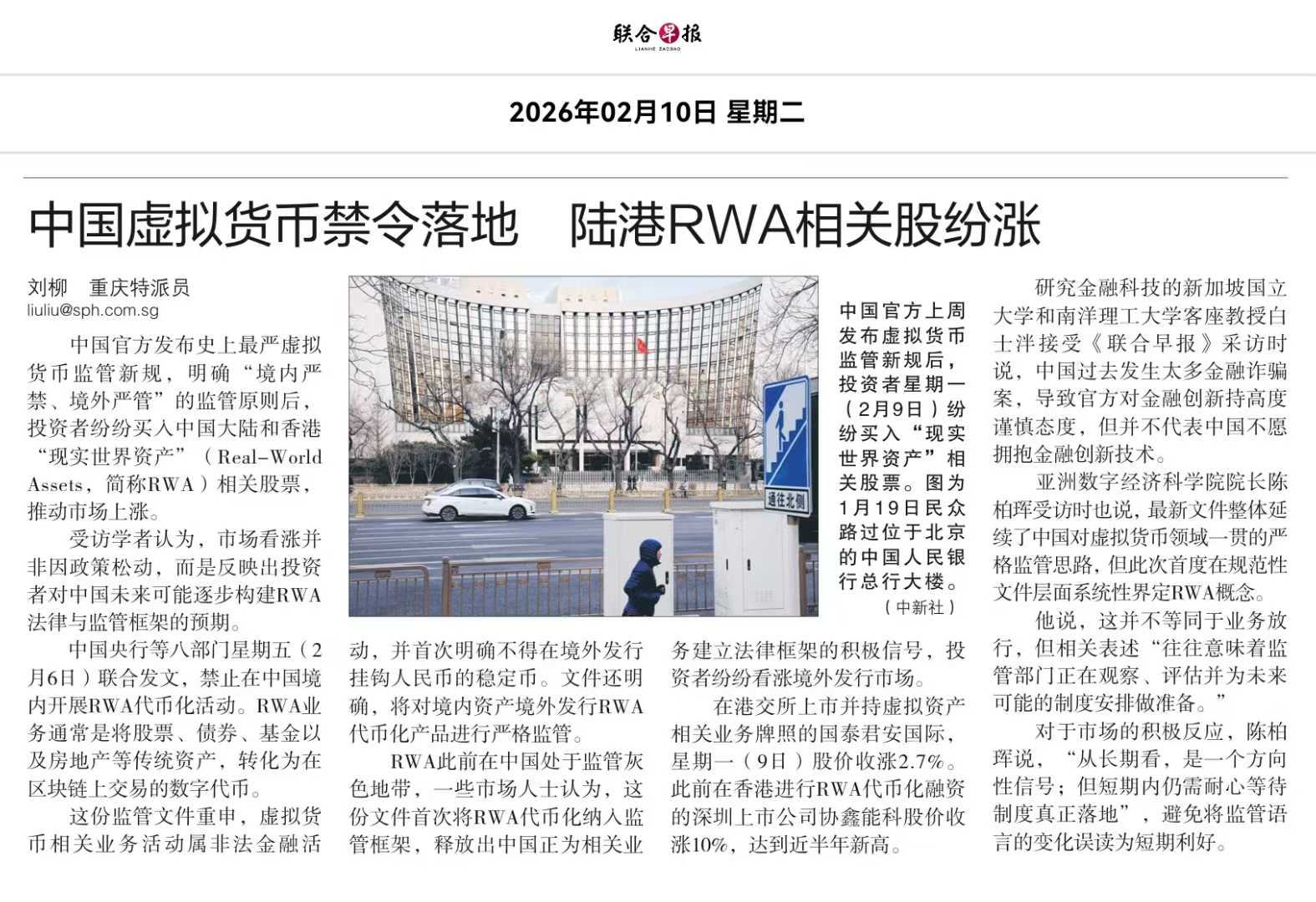
Following the joint release of the "Notice on Further Preventing and Disposing of Risks Related to Virtual Currencies" by eight Chinese central authorities, including the People's Bank of China (PBOC) and the China Securities Regulatory Commission (CSRC), industry experts have moved to parse the nuance behind the strict headlines. In an interview with Lianhe Zaobao, leadership from the Asia Academy of Digital Economics (AADE) and academic circles provided a sobering yet forward-looking analysis of China's digital asset roadmap.
A Systematic Definition of RWA
While the document maintains China’s characteristic stringency toward decentralized virtual currencies, Mr. Chen Baihui (Poh Hwee Tan), President of AADE, observed a significant evolution in the regulatory language. For the first time in a formal normative document, Chinese authorities have systematically defined the concept of Real-World Asset (RWA) tokenization.
"Defining the concept is not equivalent to greenlighting the business," Chen cautioned. "However, in the context of Chinese policymaking, such formal nomenclature often signals that regulatory departments are actively observing, evaluating, and preparing for future institutional arrangements." He noted that while the market has reacted with optimism, it is crucial to view this as a "directional signal" rather than a short-term catalyst for immediate domestic issuance.
The Strategy of "Offshore Experimentation"
Echoing this cautious sentiment, Professor Ba Shipan, Adjunct Professor at the National University of Singapore (NUS) and Nanyang Technological University (NTU), highlighted the historical context driving this prudence. He noted that China’s history of financial fraud cases has resulted in a highly vigilant stance toward financial innovation, though this should not be mistaken for a rejection of the underlying technology.
Professor Ba suggested that China is likely to continue its strategy of "offshore experimentation"—perfecting rules and frameworks in international markets like Hong Kong or Singapore first. Only once the system is proven to be controllable and orderly will the domestic market see a gradual opening.
Future Outlook: Controlled Sandboxes and Pilot Programs
Chen Baihui predicts that the likelihood of direct RWA issuance within Mainland China remains low for the next 12 to 24 months. However, as regulatory experience matures, AADE anticipates potential explorations via regulatory sandboxes or controlled pilot programs focused on specific financial infrastructures and high-quality asset classes.
This analysis aligns with AADE’s core mission of Pioneer RegTech. By championing the principle of "governing technology with technology," the Academy emphasizes that a resilient digital economy must be built on a foundation of robust compliance. Through its role in Digital Connectivity, AADE continues to bridge the gap between China’s cautious regulatory environment and the rapid innovation of the global RWA ecosystem.
As the "Digital Economy New Passage" evolves, AADE remains a vital platform for interpreting these complex regulatory shifts, ensuring that stakeholders across the Global South can navigate the path toward a secure and equitable digital future.